
Draft Red Herring Prospectus (DRHP) filing continued to be robust in October, signifying the optimism in the initial public offer (IPO) market despite the recent turbulence in equities. In October, 17 companies filed their offer documents for IPOs. The rush in filings has made August-October 2023 the best three-month period for DRHP filings since July-September 2021.

Stock markets will be driven by domestic inflation data, ongoing quarterly earnings from corporates and global trends this week, analysts said. News flows around the general election would also be tracked by investors, market experts said.

Benchmark equity indices Sensex and Nifty settled with marginal gains on Thursday in a highly volatile trade amid the scheduled monthly derivatives expiry and muted trend in the US markets. The 30-share BSE Sensex closed 86.53 points or 0.13 per cent higher at 66,988.44, registering its third day of gains. During the day, it hit a high of 67,069.89 and a low of 66,610.35.

The dealers operating in the space have jumped nearly three times over the past two years.

Equity markets may witness a gradual up-move this week with some volatility as both election and earnings season are nearing their end, analysts said, adding that global trends and trading activity of foreign investors would hold significance in dictating investors' sentiment. Benchmark indices, which had a record-breaking rally last week, would also track global oil benchmark Brent crude and the rupee-dollar trend. The monthly derivatives expiry on Thursday may also fuel volatility in markets.

'Like every Budget, this time, too, there is chatter around tinkering with the long-term capital gains tax.' 'Investors may not want to jump into the markets until there is clarity on this front.'
As many as 31 mainboard IPOs raised a cumulative Rs 26,272 crore in this period, according to Prime Database. During the April-September 2007 bull run, 48 IPOs totalling Rs 21,243 crore were launched. The number of deals in H1FY24 was 2.2 times that of the same period of the last fiscal year, but the amount raised was 26 per cent lower.

Equity benchmark Sensex slumped over 1,000 points to sink below the 55,000-level on Friday, tracking deep losses in IT, finance, banking and energy stocks amid widespread selling in the global markets. A weak rupee, surging crude prices and relentless foreign capital outflows further weighed on sentiment, traders said. The 30-share BSE index ended 1,016.84 points or 1.84 per cent lower at 54,303.44.

Among major Sensex gainers, ITC rose the most by 2.32 per cent, followed by TCS, M&M, SBI and Bharti Airtel.

The ongoing fourth quarter earnings season, global factors and macroeconomic data would guide the trends in the equity markets this week, analysts said. Markets would also take cues from trading activity of foreign investors, rupee-dollar trend and movement of global oil benchmark Brent crude. "Domestically, the next batch of Q4 earnings reports will drive stock-specific movements, Hero MotoCorp, Larsen & Toubro, BPCL, State Bank of India, Eicher Motors and Tata Motors are some of the big names in the list and the next phase of voting," said Pravesh Gour, senior technical analyst, Swastika Investmart Ltd.

From the Sensex basket, Bajaj Finance, Mahindra & Mahindra, HDFC Bank, JSW Steel, Maruti, Wipro, Bharti Airtel, Bajaj Finserv, ICICI Bank and ITC were the major gainers. Nestle India, HCL Technologies, Larsen & Toubro, Tata Consultancy Services, Tata Motors and Infosys were among the laggards.

Dalal Street investors became richer by Rs 9.68 lakh crore in five days of market rally, where the Sensex breached the historic 73,000-mark for the first time ever to reach a new record peak, taking the market capitalisation of BSE-listed companies to an all-time high of Rs 376 lakh crore. The 30-share BSE Sensex jumped 759.49 points or 1.05 per cent to settle at a new closing high of 73,327.94 on Monday. During the day, it zoomed 833.71 points or 1.14 per cent to reach its all-time peak of 73,402.16.
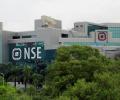
Jio Financial Services Limited, the demerged financial services unit of Reliance Industries, will be excluded from various indices of NSE, including the benchmark Nifty 50, from September 7. Shares of Jio Financial got listed on the stock exchanges on August 21, after its spin-off from parent Reliance Industries. In accordance with the index methodology, as JIOFIN has not hit price band on two consecutive trading days on September 4 and 5 at NSE, the Index Maintenance Sub Committee (Equity) of NSE Indices Ltd has decided to exclude JIOFIN from various indices effective from September 7, 2023 (close of September 6, 2023), as per a statement by NSE Indices Ltd on Tuesday.

Among the Sensex firms, Tata Steel, Tata Motors, Asian Paints, Wipro, State Bank of India and Larsen & Toubro were the major gainers. ICICI Bank, NTPC, Axis Bank and Mahindra & Mahindra were among the laggards.

Reliance Industries was the top gainer in the Sensex pack, soaring nearly 6 per cent, followed by M&M, HDFC twins, Kotak Bank, ITC and Bharti Airtel.
Maruti was the top gainer in the Sensex pack, rallying nearly 4 per cent, followed by PowerGrid, ITC, NTPC, SBI, M&M, Kotak Bank and HDFC Bank. On the other hand, TCS was the top loser on the Sensex, shedding over 6 per cent.
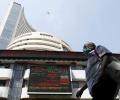
Asian Paints was the top gainer in the Sensex pack, spurting over 4 per cent, followed by Bajaj Finance, Bajaj Finserv, IndusInd Bank and Maruti. On the other hand, Titan, HCL Tech, Infosys, Sun Pharma and M&M were among the laggards.

The sharp fall in the rupee's value against the dollar during the July-September quarter, it turns out, has come as a boon for corporate earnings.

'If the NDA comes to power with 320-330 plus seats, then we could see some correction. We could possibly see a level of 19,500 to 20,000.' 'If the NDA comes to power with a majority of 400-plus, we could see the markets going to about 23,500-24,000 levels.' 'And from there we could see some correction because markets are expensive at this point of time and a correction is overdue.'

Among the Sensex shares, Infosys rose the most by 1.37 per cent, followed by Larsen & Toubro (0.90 per cent), and Wipro (0.83 per cent). HDFC Bank, ICICI Bank, Reliance Industries, ITC, TCS, Kotak Bank, Asian Paints and Titan were among the lead gainers.

Information technology (IT) companies have been on the road to revival in the past one year. From being the worst-hit sector in 2022 with a loss of 26 per cent, the Nifty IT index closed 2023 with gains of 24 per cent. So far in 2024, the index is up around 7 per cent against the nearly flat Nifty 50 benchmark index. The IT index has been on a continuous decline in the last three sessions.
Among the Sensex firms, Axis Bank, Mahindra & Mahindra, Wipro, Tata Motors, HDFC Bank, Tech Mahindra, ICICI Bank, JSW Steel, Tata Consultancy Services, Infosys, HCL Technologies and Bharti Airtel were the major gainers. Nestle, Titan, Bajaj Finserv and UltraTech Cement were the laggards.
'If individual stocks start falling 25% to 30% or more, then I doubt how many of them will be able to withstand that (kind of selloff). That is when you'll see panic coming in.'
Based on a feedback, the exchange could cap a sector's weight at 25 per cent, or align with the broader market.

Dr Reddy's was the top gainer in the Sensex pack, rising over 3 per cent, followed by PowerGrid, TCS, HCL Tech, Infosys and Reliance Industries. On the other hand, L&T, IndusInd Bank, Bajaj Finserv and Bharti Airtel were among the laggards.

Despite taking a hit on profitability amid the pandemic, companies with strong balance sheets are gaining market share because of consolidation in their respective sectors.

Brokerages expect Nifty50 companies to have cumulatively witnessed strong double-digit growth in their earnings in the first quarter of FY24 (Q1FY24). This growth in the combined earnings is expected to have been driven by banks, automakers, and oil & gas companies. Other sectors may report muted profit growth.

The domestic equity markets are expected to extend gains following the strong showing of the Narendra Modi-led Bharatiya Janata Party (BJP) in the state elections - a crucial precursor to the general elections in May. The BJP decisively secured victories in three of the four key states - Madhya Pradesh, Rajasthan, and Chhattisgarh. While the battles in these three states were closely contested, the scale of the BJP's triumph has surprised many, heightening expectations for regime continuity in 2024 - a positive catalyst for the markets.

Given gains in equity prices, it is not surprising that the earnings of asset management companies (AMCs) are growing quicker. The earnings momentum looks set to continue. Good fund performances have thus led to AMC earnings upgrades although valuations are high. Recent market performance and net flow trends have led to earnings upgrades by between 3-8 per cent for FY25-27.

The S&P BSE Sensex and the Nifty50 have hit record highs amid the poll outcome-triggered bull frenzy at the bourses. Most analysts feel that the indices are on course to rise further over the next few months - till the general elections - albeit amid intermittent corrections - largely triggered by global developments. Bharatiya Janata Party's (BJP's) win in the three state elections of Madhya Pradesh (MP), Rajasthan and Chhattisgarh, analysts at Jefferies believe, reinforces the consensus expectations of a Modi win 2024 national elections with a greater likelihood of over 300 seats for the BJP.
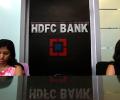
With Housing Development Finance Corporation's (HDFC's) merger with HDFC Bank becoming effective on July 1, the merged entity is set to become the top weight in the benchmarks S&P BSE Sensex and the National Stock Exchange Nifty indices, dislodging the country's most valuable company, Reliance Industries (RIL), from its perch. HDFC will stop trading after July 13. At present, RIL has a weighting of close to 12 per cent in the Sensex and 10.3 per cent in the broad-based Nifty. Meanwhile, HDFC Bank and HDFC have weights of 9.9 per cent and 6.8 per cent in the Sensex and 8.8 per cent and 6 per cent in the Nifty, respectively.

Stock markets will be driven by quarterly earnings by index majors, global trends and the RBI's interest rate decision this week after digesting news on budget proposals and US Federal policy outcome, say analysts. The trading activity of foreign investors and the movement of global oil benchmark Brent crude would also dictate trends in equities. "On the domestic front, the MPC (Monetary Policy Committee) meeting is scheduled from February 6-8.

The trend in corporate earnings suggests that index earnings could fall to the levels last seen in early 2014.

'India has entered an economic super-cycle driven by a housing cycle turnaround.'

The fast-moving consumer goods (FMCG) sector has underperformed the Nifty over the past year as its 20 per cent return is trumped by 29 per cent of the benchmark index. The FMCG index saw a 2.2 per cent drop in the last session, while the Nifty lost 1 per cent. FMCG is seen as a defensive segment. The demand for staples like personal care products, groceries and snacks tend to be stable. FMCG companies are consistent dividend-payers.
These stocks offer the best combination of maximum 'buy' recommendations from brokerages and share price upside over the next 12 months.

Prominent exits by promoters included a Rs 15,300 crore share sale in Indus Tower by Vodafone Plc, a Rs 9,300 crore share sale by the Tata group in Tata Consultancy Services.

Among the Sensex firms, ICICI Bank and SBI led the index with the maximum gains of 4.68 per cent and 3.99 per cent, respectively. Other major gainers were Larsen & Toubro, Kotak Mahindra Bank and HDFC Bank. On the other hand, Wipro and Tata Motors defied the trend and traded in negative.

Domestic investors are tightening their grip on the ownership of listed companies. The gap between the shareholding of domestic institutional investors (DIIs) and foreign portfolio investors (FPIs) narrowed to 13.11 percentage points at the end of the September 2023 quarter. At the peak, the gap was nearly 50 percentage points in March 2015, according to an analysis by Prime Database, a leading provider of data on the capital market.

Among the Sensex firms, Bajaj Finance fell by nearly 3 per cent, the most among the 30 frontline companies. Bajaj Finserv, Axis Bank, HDFC Bank, Reliance Industries, NTPC, ICICI Bank and IndusInd Bank were the other major laggards. In contrast, Tata Motors, Sun Pharma, Maruti and Mahindra & Mahindra were the gainers.
 © 2026 Rediff.com - Advertise with us - Disclaimer - Privacy Policy - Sitemap - Feedback - About us - Terms of use - Grievances